
"Holding Court" John A. Macdonald Statue
Consultation has concluded
Public feedback for this project has now closed.
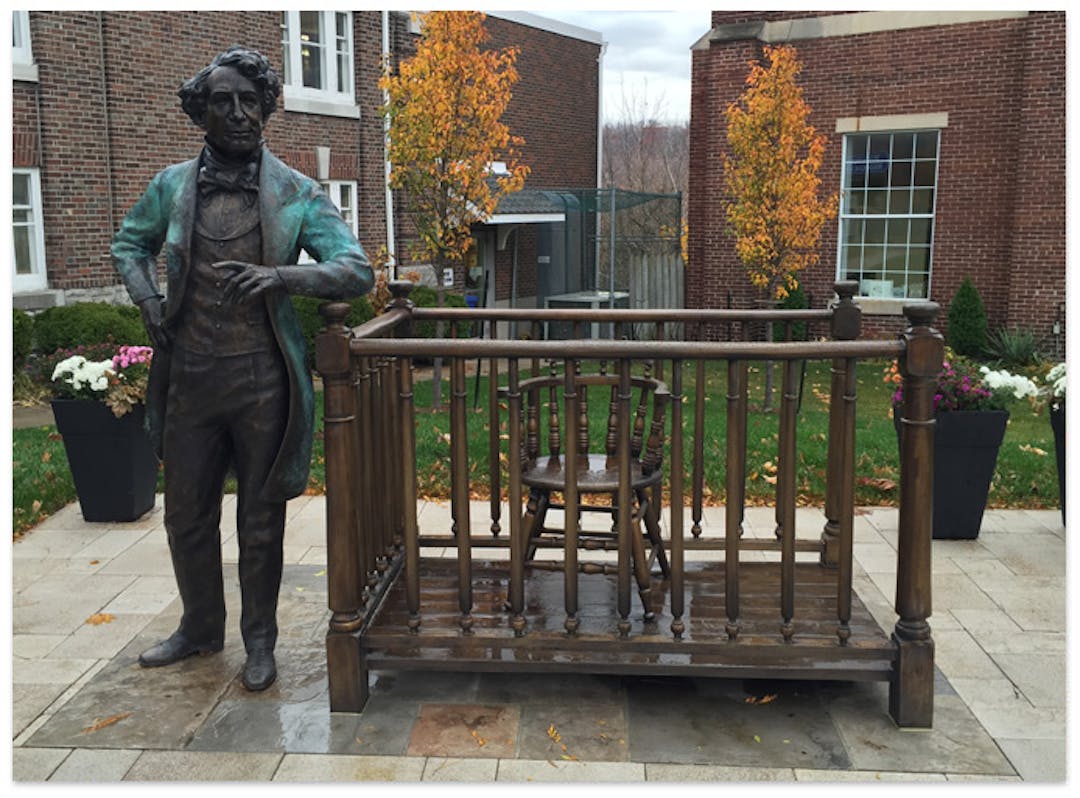
The “Holding Court” John A. Macdonald statue will remain in its current location on Picton Main Street following a decision by County Council at a special meeting on Tuesday, November 17. Read more on the County of Prince Edward website.
The Sir John A. Macdonald statue "Holding Court" was returned from storage to Picton Main Street at the Picton Library in early 2020 (after its original installation in 2015). Its return was a catalyst for conversation about Sir John A. Macdonald's past, within the broader context of colonialism. From this conversationContinue reading
Public feedback for this project has now closed.
The “Holding Court” John A. Macdonald statue will remain in its current location on Picton Main Street following a decision by County Council at a special meeting on Tuesday, November 17. Read more on the County of Prince Edward website.
The Sir John A. Macdonald statue "Holding Court" was returned from storage to Picton Main Street at the Picton Library in early 2020 (after its original installation in 2015). Its return was a catalyst for conversation about Sir John A. Macdonald's past, within the broader context of colonialism. From this conversation came the Prince Edward County Public Library's Speaker Series (Dr. Niigan Sinclair, Sarah Midanik, Kateri Lucier-Laboucan and Calvin Brook) addressed the need for projects which aim to restore Indigenous presence within communities, among other things. Other speakers were scheduled into March, but the COVID-19 pandemic caused the series to be cancelled due to public health measures.
The "Holding Court" Statue Working Group" was formed under the Prince Edward Heritage Advisory Committee (PEHAC) to conduct public consultation, research and ultimately to make recommendations to PEHAC about the future of the "Holding Court" statue. Their mandate is to advise PEHAC in their recommendation to Council in regard to the current installation in Picton of the "Holding Court" Sir John A. Macdonald statue.
Their goals are as follows:
- Follow the scope of the Truth and Reconciliation Commission's 10 Principles of Truth and Reconciliation
- Conduct research, carry out public consultation and prepare documentation, as necessary, to assist PEHAC in their recommendation to assist Council in their decision on the future of the Holding Court" statue
- Assist staff to prepare a report to PEHAC and ultimately Council by December 1, 2020, or as soon as feasible, outlining a recommendation for the future of the "Holding Court" statue.
Through this Have Your Say public engagement page, the Working Group will share information relevant to the public discussion, including their terms of reference, the 10 Principles of Truth and Reconciliation, and other documents (located in "Resources").
The Working Group would like to hear your views on what should be done with the "Holding Court" statue.
Individuals and organizations can tell the Working Group their views:
- Directly (in person or virtually) by presenting deputations (see "Deputation Guidelines" for more information on making public deputations)
- During a Town Hall event planned for Fall 2020.
- Via email to: ecowan@pecounty.on.ca
- By fax at: 613.476.5727
- By mail to: The "Holding Court” Statue Working Group, c/o County of Prince Edward, 332 Main Street, Picton, ON, K0K 2T0.
Please note that deputations and all comments are public.
Please explore the feedback options available on this page (below) to give your feedback. Register for updates to this page to get notified when new consultation tools are added as the Working Group progresses towards their goal.
In the words of Dr. Niigan Sinclair during his address in Picton, "What do we do with this history we have inherited together?"
Tell us what the Holding Court statue means to you?
-
Share The County has already clearly spoken on Facebook Share The County has already clearly spoken on X (formerly Twitter) Share The County has already clearly spoken on Linkedin Email The County has already clearly spoken link
The County has already clearly spoken
by vdetour, about 6 years ago
The "holding court" statue is a vestige of a time when white men ruled over everyone else, sometime brutally. It's been a long road to us, as a culture, finally starting to collectively stand against such injustice.
The OPP confirmed that over 1000 people laid face-down for 9 minutes on Picton Main St. on June 6 as part of the peaceful Black Lives Matter protest.
We can celebrate Sir John A's accomplishments without this statue. Please remove it from Picton main st.
The "holding court" statue is a vestige of a time when white men ruled over everyone else, sometime brutally. It's been a long road to us, as a culture, finally starting to collectively stand against such injustice.
The OPP confirmed that over 1000 people laid face-down for 9 minutes on Picton Main St. on June 6 as part of the peaceful Black Lives Matter protest.
We can celebrate Sir John A's accomplishments without this statue. Please remove it from Picton main st. -
Share Time for a different history on Facebook Share Time for a different history on X (formerly Twitter) Share Time for a different history on Linkedin Email Time for a different history link
Time for a different history
by Jess Posgate, about 6 years agoIt's time to change how we represent the past and who we celebrate with public monuments. There are many good arguments on both sides already stated. I suggest that prince edward county lead and innovate in our public spaces, instead of following the overused paths of celebrating people and events that represent only one side of what makes up our history.
It's time to change how we represent the past and who we celebrate with public monuments. There are many good arguments on both sides already stated. I suggest that prince edward county lead and innovate in our public spaces, instead of following the overused paths of celebrating people and events that represent only one side of what makes up our history.
-
Share It should go. on Facebook Share It should go. on X (formerly Twitter) Share It should go. on Linkedin Email It should go. link
It should go.
by Melanie Dailey, about 6 years agoThe statue represents different things for different people... and it seems we can debate that from here until eternity. For me, the bottom line is that it is in a shared public space and if it makes people feel unwelcome in this community, unequal, unsafe, uncomfortable, or harmed, it should go. There is simply no justification for keeping it. I cringe every time I look at it.The statue represents different things for different people... and it seems we can debate that from here until eternity. For me, the bottom line is that it is in a shared public space and if it makes people feel unwelcome in this community, unequal, unsafe, uncomfortable, or harmed, it should go. There is simply no justification for keeping it. I cringe every time I look at it. -
Share Too Painful on Facebook Share Too Painful on X (formerly Twitter) Share Too Painful on Linkedin Email Too Painful link
Too Painful
by Jane McGall, about 6 years agoI believe that Indigenous folks who visit the library should not need to walk by a visual reminder of a racist man who actively tried to eliminate their culture. It hurts me to walk by this statue because it reads as a glorification of a spectacularly hideous part of our past. How about we honour the survivors of the residential school system and the efforts being made to reclaim language and culture by first nations peoples, and not their oppressors?The statue must be removed because it is too painful for it to remain.
I believe that Indigenous folks who visit the library should not need to walk by a visual reminder of a racist man who actively tried to eliminate their culture. It hurts me to walk by this statue because it reads as a glorification of a spectacularly hideous part of our past. How about we honour the survivors of the residential school system and the efforts being made to reclaim language and culture by first nations peoples, and not their oppressors?The statue must be removed because it is too painful for it to remain.
-
Share Be the center of attention amid a crowd of one's admirers on Facebook Share Be the center of attention amid a crowd of one's admirers on X (formerly Twitter) Share Be the center of attention amid a crowd of one's admirers on Linkedin Email Be the center of attention amid a crowd of one's admirers link
Be the center of attention amid a crowd of one's admirers
by Joanne Barrett, about 6 years ago"Be the center of attention amid a crowd of one's admirers"
That is the definition of one who "holds court". When I look at the statue I feel it is intended to portray an admirable "person of justice". While John A. Macdonald may have many admirable historical accomplishments, I do not perceive him as a "person of justice", given his treatment of Indigenous people; nor do I admire him because of that abuse and racism. Not every one agreed with his atrocities at that time in history and many pleaded with him to stop. Even if the entire world agreed... Continue reading
"Be the center of attention amid a crowd of one's admirers"
That is the definition of one who "holds court". When I look at the statue I feel it is intended to portray an admirable "person of justice". While John A. Macdonald may have many admirable historical accomplishments, I do not perceive him as a "person of justice", given his treatment of Indigenous people; nor do I admire him because of that abuse and racism. Not every one agreed with his atrocities at that time in history and many pleaded with him to stop. Even if the entire world agreed with his abusive treatment of Indigenous persons, would that then make it OK? I think not.
If the statue portrayed his other accomplishments perhaps would be more appropriate. I am an individual with Métis heritage, and I find it offensive to honor him with a statue that would portray him as a "person of justice". A statue related to the Canada project perhaps, but a person of justice, I think not.
No offense intended to the artist. It is a lovely piece of art if it were a different subject matter.
-
Share History shouldn’t always be told be the winners on Facebook Share History shouldn’t always be told be the winners on X (formerly Twitter) Share History shouldn’t always be told be the winners on Linkedin Email History shouldn’t always be told be the winners link
History shouldn’t always be told be the winners
by Nell Casson, about 6 years agoThis statue has no business being on the Main Street of Picton. Rehome Sir John A in a museum where he can have his larger story told to people who want to educate themselves.As an artist I appreciate inclusive and educational public art, but audiences don’t read; and shouldn’t have too read just to understand a piece of art. A plaque wont be enough to provide the full context of the complicated history that Sir John A represents.
Having this monument, without offering any context, as one of the features of Main St Picton sends a message of hero... Continue readingThis statue has no business being on the Main Street of Picton. Rehome Sir John A in a museum where he can have his larger story told to people who want to educate themselves.As an artist I appreciate inclusive and educational public art, but audiences don’t read; and shouldn’t have too read just to understand a piece of art. A plaque wont be enough to provide the full context of the complicated history that Sir John A represents.
Having this monument, without offering any context, as one of the features of Main St Picton sends a message of hero worship. It is offensive. It is not representative of the values our town should be projecting. If our town is not welcoming to indigenous populations, who’s next?
To be callous to a group because we lack the empathy to understand their view, speaks to our place of privilege. To make the choice not to amend this wrong speaks to our ignorance. To defend our own ignorance is mean, cruel and wrong. Removing the statue is the right choice. -
Share Honouring Genocide and White Supremacy is Wrong on Facebook Share Honouring Genocide and White Supremacy is Wrong on X (formerly Twitter) Share Honouring Genocide and White Supremacy is Wrong on Linkedin Email Honouring Genocide and White Supremacy is Wrong link
Honouring Genocide and White Supremacy is Wrong
by Riel Brown, about 6 years agoStatues are not history lessons. They are monuments that honour and memorialize an individual or an event.History lessons are taught in families, schools and communities, and should not be conflated with statues.
John A. MacDonald was Canada's first Prime Minister and he both endorsed and instituted the genocide of the Indigenous Nations of what is now known as Canada. He was an avid white supremist who supported the enslavement and ownership of black and brown-skinned human beings by white-skinned human beings.
He was not a good or honourable man, and he should not hold a place of honour in this... Continue readingStatues are not history lessons. They are monuments that honour and memorialize an individual or an event.History lessons are taught in families, schools and communities, and should not be conflated with statues.
John A. MacDonald was Canada's first Prime Minister and he both endorsed and instituted the genocide of the Indigenous Nations of what is now known as Canada. He was an avid white supremist who supported the enslavement and ownership of black and brown-skinned human beings by white-skinned human beings.
He was not a good or honourable man, and he should not hold a place of honour in this or any community. -
Share Use Your Imagination on Facebook Share Use Your Imagination on X (formerly Twitter) Share Use Your Imagination on Linkedin Email Use Your Imagination link
Use Your Imagination
by June Johnston, about 6 years agoA statue is not part of history. So removing it does not rewrite history.I learned in high school history from a very smart teacher the importance of looking at “Primary Sources” when evaluating historical events. If you look at letters and documents written by Sir John A., you find a racist, mean-spirited person who showed contempt for Indigenous people. Even taken in context for its time, this attitude is not something to celebrate by displaying a statue on Main Street Picton.
Try to imagine you are an Indigenous person who has to drive by that statue every day on... Continue reading
A statue is not part of history. So removing it does not rewrite history.I learned in high school history from a very smart teacher the importance of looking at “Primary Sources” when evaluating historical events. If you look at letters and documents written by Sir John A., you find a racist, mean-spirited person who showed contempt for Indigenous people. Even taken in context for its time, this attitude is not something to celebrate by displaying a statue on Main Street Picton.
Try to imagine you are an Indigenous person who has to drive by that statue every day on the way to work.
By the way, I would like to ask why almost all statues are of men? Aren’t there any famous women to commemorate?Lastly, I think having a person who originally helped bring the statue to Picton on the committee to recommend its fate is just wrong.
-
Share John A. monument on Facebook Share John A. monument on X (formerly Twitter) Share John A. monument on Linkedin Email John A. monument link
John A. monument
by Richard Pearse, about 6 years agoIt is a monument that remembers an important leader who grew up in Glenora, became a barrister, and then went on to be a leader in the establishment of this great country. John A. was a driving force for the Canada project, and was an enlightened man of his time. The monument should retain its place of pride in front of the library. It attracts many, and while Residential Schools are now seen as unjustified, when he participated in their establishment they were voluntary and introduced with the support of many indigenous leaders. We should not be tearing down monuments... Continue reading
It is a monument that remembers an important leader who grew up in Glenora, became a barrister, and then went on to be a leader in the establishment of this great country. John A. was a driving force for the Canada project, and was an enlightened man of his time. The monument should retain its place of pride in front of the library. It attracts many, and while Residential Schools are now seen as unjustified, when he participated in their establishment they were voluntary and introduced with the support of many indigenous leaders. We should not be tearing down monuments to such leaders, but remember their good works, while debating how Canada moves forward.
We can debate and, if we look hard enough, find fault with most leaders of that era, including men like John A. and indigenous leaders. But we need to accept that they were people of their time and see them in the context of that period in history, not by current ideal standards.
-
Share Scapegoating? on Facebook Share Scapegoating? on X (formerly Twitter) Share Scapegoating? on Linkedin Email Scapegoating? link
Scapegoating?
by Robert (Bob) Burkinshaw, about 6 years agoI oppose removing the Holding Court statue of Macdonald. The motive for removing it is laudable in the sense that people do not want to honour a prime minister whose government mistreated Aboriginal people. However, removing Macdonald's statue is too simplistic a solution because it does not address the problem that Canadian society in general was quite racist and supportive of racist policies in his time. Macdonald was not unique in that regard and removing his statue seems to be a form of scapegoating. In fact, the situation might have been worse for Aboriginals if others were in power instead... Continue reading
I oppose removing the Holding Court statue of Macdonald. The motive for removing it is laudable in the sense that people do not want to honour a prime minister whose government mistreated Aboriginal people. However, removing Macdonald's statue is too simplistic a solution because it does not address the problem that Canadian society in general was quite racist and supportive of racist policies in his time. Macdonald was not unique in that regard and removing his statue seems to be a form of scapegoating. In fact, the situation might have been worse for Aboriginals if others were in power instead of Macdonald.
For example:
- During the debates about providing food for western Aboriginals in the federal budget, the official opposition critic, David Mills, did not ask that the amount of money be more generous. Instead, he argued against providing food to Aboriginals who did not want to become farmers on the grounds that doing so would frustrate the law of "the survival of the fittest."
- It is true that the federal government's involvement in residential schools began during Macdonald's time as prime minister. However, succeeding governments of both major parties did not react in horror to what his government had begun but, instead, continued to build on the system of residential schools for many decades. Mandatory attendance at those schools came after Macdonald's death.
- While Macdonald was able to convince Parliament to grant voting rights to Aboriginals in Eastern Canada in 1885, Parliament refused to support his proposal to grant the vote to Western Aboriginals. In fact, within a few years of Macdonald's death, the Laurier government stripped the right to vote from Aboriginals altogether and it was not until 1960 that Aboriginals were granted the right to vote federally.
if we remove Macdonald's statue because of what happened to Aborginals in Western Canada, we would be in danger of avoiding the fact that almost all of our elected officials and the general public were guilty in their views and treatment of Aboriginals. We do not encourage reconciliation when we scapegoat one person but ignore the wider problem in society.
instead of removing the statue, there may be merit in adding an additional plaque on the statue which indicates that Macdonald's government did enact policies towards Aboriginals which reflected the racist views of his times.
-
 Agendas & Meeting Notes
-
Resources & Further Reading
-
 Municipal World Podcast - Interview w. Ava Hill Pt. 3
-
Municipal World Podcast - Interview w. Ava Hill Pt. 2
-
Municipal World Podcast - Interview w. Ava Hill Pt. 1
-
The Survivors Speak - Report of the TRC Canada.pdf (8.29 MB) (pdf)
-
Ryerson - TRC Community Report.pdf (347 KB) (pdf)
-
Framework-for-History-and-Commemoration-2019.pdf (6.55 MB) (pdf)
-
Final Report - Working Grp on Principles of Commemoration and Renaming.pdf (937 KB) (pdf)
-
United Nations Declaration of the Rights of Indigenous People.pdf (150 KB) (pdf)
-
Truth & Reconclitation Commission, 10 Principles of Reconcilliation.docx (19.9 KB) (docx)
-
-
History of "Holding Court" statue

-
Heritage Advisory Committee Working Group
County of Prince Edward
HC -
Phone 613-476-2148 x2503 Email ecowan@pecounty.on.ca -
NL

-
Open
"Holding Court" John A. Macdonald Statue has finished this stageThis consultation is Open for contributions.
-
Under Review
"Holding Court" John A. Macdonald Statue has finished this stageContributions to this consultation are closed for evaluation and review. The Project team will report back on key outcomes.
-
Final report
"Holding Court" John A. Macdonald Statue is currently at this stageThe final outcomes of the consultation are documented here. This may include a summary of all contributions collected as well as recommendations for future action.