
"Holding Court" John A. Macdonald Statue
Consultation has concluded
Public feedback for this project has now closed.
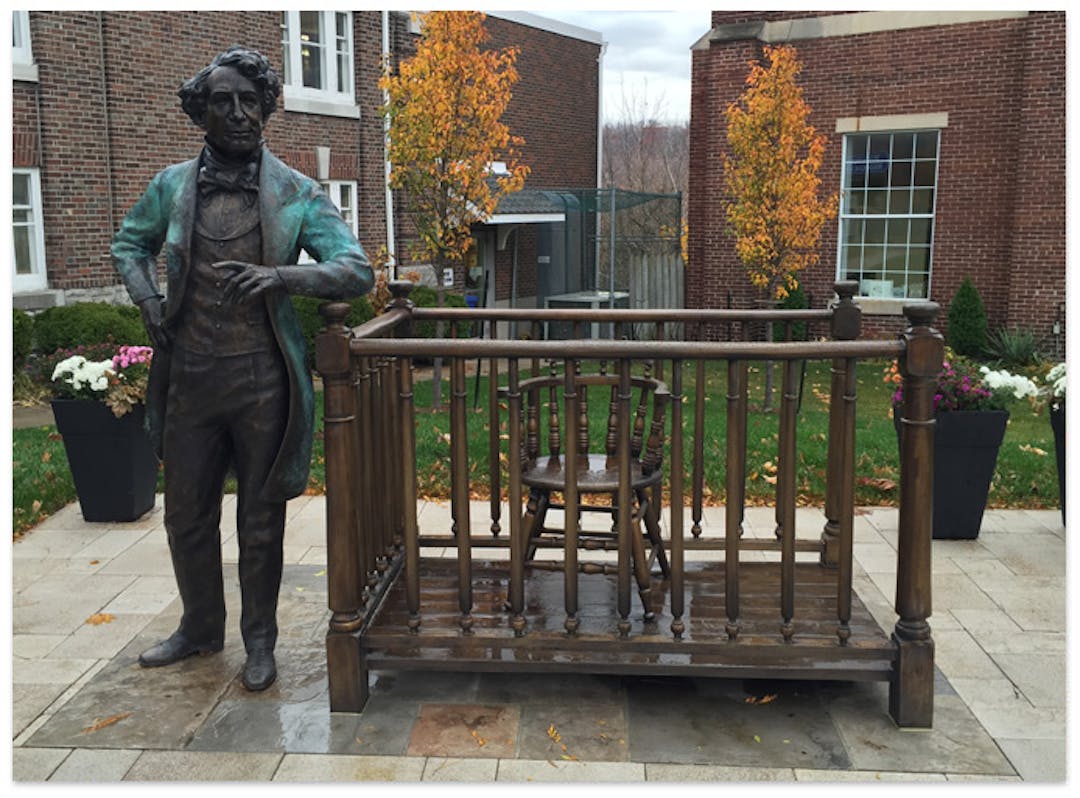
The “Holding Court” John A. Macdonald statue will remain in its current location on Picton Main Street following a decision by County Council at a special meeting on Tuesday, November 17. Read more on the County of Prince Edward website.
The Sir John A. Macdonald statue "Holding Court" was returned from storage to Picton Main Street at the Picton Library in early 2020 (after its original installation in 2015). Its return was a catalyst for conversation about Sir John A. Macdonald's past, within the broader context of colonialism. From this conversationContinue reading
Public feedback for this project has now closed.
The “Holding Court” John A. Macdonald statue will remain in its current location on Picton Main Street following a decision by County Council at a special meeting on Tuesday, November 17. Read more on the County of Prince Edward website.
The Sir John A. Macdonald statue "Holding Court" was returned from storage to Picton Main Street at the Picton Library in early 2020 (after its original installation in 2015). Its return was a catalyst for conversation about Sir John A. Macdonald's past, within the broader context of colonialism. From this conversation came the Prince Edward County Public Library's Speaker Series (Dr. Niigan Sinclair, Sarah Midanik, Kateri Lucier-Laboucan and Calvin Brook) addressed the need for projects which aim to restore Indigenous presence within communities, among other things. Other speakers were scheduled into March, but the COVID-19 pandemic caused the series to be cancelled due to public health measures.
The "Holding Court" Statue Working Group" was formed under the Prince Edward Heritage Advisory Committee (PEHAC) to conduct public consultation, research and ultimately to make recommendations to PEHAC about the future of the "Holding Court" statue. Their mandate is to advise PEHAC in their recommendation to Council in regard to the current installation in Picton of the "Holding Court" Sir John A. Macdonald statue.
Their goals are as follows:
- Follow the scope of the Truth and Reconciliation Commission's 10 Principles of Truth and Reconciliation
- Conduct research, carry out public consultation and prepare documentation, as necessary, to assist PEHAC in their recommendation to assist Council in their decision on the future of the Holding Court" statue
- Assist staff to prepare a report to PEHAC and ultimately Council by December 1, 2020, or as soon as feasible, outlining a recommendation for the future of the "Holding Court" statue.
Through this Have Your Say public engagement page, the Working Group will share information relevant to the public discussion, including their terms of reference, the 10 Principles of Truth and Reconciliation, and other documents (located in "Resources").
The Working Group would like to hear your views on what should be done with the "Holding Court" statue.
Individuals and organizations can tell the Working Group their views:
- Directly (in person or virtually) by presenting deputations (see "Deputation Guidelines" for more information on making public deputations)
- During a Town Hall event planned for Fall 2020.
- Via email to: ecowan@pecounty.on.ca
- By fax at: 613.476.5727
- By mail to: The "Holding Court” Statue Working Group, c/o County of Prince Edward, 332 Main Street, Picton, ON, K0K 2T0.
Please note that deputations and all comments are public.
Please explore the feedback options available on this page (below) to give your feedback. Register for updates to this page to get notified when new consultation tools are added as the Working Group progresses towards their goal.
In the words of Dr. Niigan Sinclair during his address in Picton, "What do we do with this history we have inherited together?"
Tell us what the Holding Court statue means to you?
-
Share Statues glorify, they don’t teach on Facebook Share Statues glorify, they don’t teach on X (formerly Twitter) Share Statues glorify, they don’t teach on Linkedin Email Statues glorify, they don’t teach link
Statues glorify, they don’t teach
by Bethany MacInnes, about 6 years agoThe statue of Macdonald on Picton Main Street glorifies a person who perpetrated a deliberate genocide of indigenous people; he put into place policies that are still negatively affecting indigenous people today. Why would we honour that person with a statue? Because he started his legal practice in our area?The statute should be completely removed from Main Street. Putting up a plaque as some suggest to tell “the other side“ of Macdonald’s Legacy isn’t good enough. We cannot say that as a country we are committed to reconciliation when we continue to glorify despicable people.
To those who say... Continue readingThe statue of Macdonald on Picton Main Street glorifies a person who perpetrated a deliberate genocide of indigenous people; he put into place policies that are still negatively affecting indigenous people today. Why would we honour that person with a statue? Because he started his legal practice in our area?The statute should be completely removed from Main Street. Putting up a plaque as some suggest to tell “the other side“ of Macdonald’s Legacy isn’t good enough. We cannot say that as a country we are committed to reconciliation when we continue to glorify despicable people.
To those who say that removing the statue is somehow erasing history, I would like to remind them that the statue has only been in place for five years. We aren’t talking about a A historic art piece in our town. It was commissioned and put in place by people with money and privilege. It was moved onto public property without consulting the public. It should never have been installed in the first place. -
Share My Thoughts on the JAM Statue on Facebook Share My Thoughts on the JAM Statue on X (formerly Twitter) Share My Thoughts on the JAM Statue on Linkedin Email My Thoughts on the JAM Statue link
My Thoughts on the JAM Statue
by Annelise Noronha, about 6 years agoTo whom it may concern
I am a person of colour and an immigrant in this great country of ours. Because of such, my feelings are often contradictory with regards to colonialism in Canada. Without said colonizing of Canada, my family would not have come here...india to east africa to England and finally to Canada. Without the blanket of the commonwealth and an allegiance to the Queen, I would not enjoy the freedoms Canada has to offer. On the other hand, despite having the same freedoms and rights as most Canadians, my colour leaves me a victim of racism on... Continue reading
To whom it may concern
I am a person of colour and an immigrant in this great country of ours. Because of such, my feelings are often contradictory with regards to colonialism in Canada. Without said colonizing of Canada, my family would not have come here...india to east africa to England and finally to Canada. Without the blanket of the commonwealth and an allegiance to the Queen, I would not enjoy the freedoms Canada has to offer. On the other hand, despite having the same freedoms and rights as most Canadians, my colour leaves me a victim of racism on occasion, and often feeling marginalized when expressing my feelings on the subject.
The history I learned in school here in Canada did not include the deep racism and the outright stealing of land. It did not include the mental and physical rape of Indigenous children in residential schools. It did not include the segregation of black people throughout Canada. And it certainly did not include the darker qualities of John A. MacDonald.
As I have learned these things in the last few years, I feel a deep shame that the life I can enjoy here, even as a minority, exists because of atrocities committed to our First Nations people. When I walk by that statue on main street, John A.'s smug face gives me a knot in my stomach. A knot of shame. A knot of empathy for the actual people whose life paths have been permanently altered. Whose families have been erased from history.
This statue belongs in a museum. John A. is a large part of our history and the freedoms that most Canadians enjoy. And should be commemorated in a building that is meant to hold the past. Not in a public place. A public place should be a reflection of our present day society. And now that we have learned the truth about MacDonald, ours should be not to continue to torment the indigenous, nor create a feeling of shame inside many others of us. Ours should be of reconciliation, inclusion, justice and equity.
Best,Annelise Noronha
-
Share New Knowledge on Facebook Share New Knowledge on X (formerly Twitter) Share New Knowledge on Linkedin Email New Knowledge link
New Knowledge
by Anne , about 6 years agoFor most of my 56 years, all I really knew about Sir John A. Macdonald was that he was Canada’s first Prime Minister, and he is on our $10 bill. I now have new knowledge about him. Now I know about his key role in Canada’s horrific treatment of our Indigenous People. I am at a loss to understand why having his statue (in front of the library of all places - where knowledge is stored!!) is even a topic for discussion?? There are so many other good options for us to choose from for a statue on our Main... Continue reading
For most of my 56 years, all I really knew about Sir John A. Macdonald was that he was Canada’s first Prime Minister, and he is on our $10 bill. I now have new knowledge about him. Now I know about his key role in Canada’s horrific treatment of our Indigenous People. I am at a loss to understand why having his statue (in front of the library of all places - where knowledge is stored!!) is even a topic for discussion?? There are so many other good options for us to choose from for a statue on our Main Street. Someone / something ALL Canadians can be proud of. What a wonderful way to unite everyone! No one can win when we are arguing over whether or not to continue having a person hold a place of prominence in our town who we know did not treat all Canadians with respect. He certainly was not “Holding Court” for our Indigenous People! It is a fact that his policies, and the damage done by his actions, continue to cause great pain today. We just cannot he ok with this - not now that we all know about it! Right!!?
-
Share FRATERNITY AND GOVERNMENT on Facebook Share FRATERNITY AND GOVERNMENT on X (formerly Twitter) Share FRATERNITY AND GOVERNMENT on Linkedin Email FRATERNITY AND GOVERNMENT link
FRATERNITY AND GOVERNMENT
by Brenda Everall, about 6 years agoI‘ll add my opinion here, though I am loathe to engage with my former community due to a severe oppression campaign that I experienced from members of that community, which subsequently alienated me away from that area in poor health and extreme poverty.My attempts to blow the whistle on sexual abuse in foster care were met with serious opposition from a network of people in PEC. I eventually found a document called “Blessed Be The Tie That Binds“ that revealed a shadow government to me and how it was affecting the community. I eventually went on to discover a... Continue reading
I‘ll add my opinion here, though I am loathe to engage with my former community due to a severe oppression campaign that I experienced from members of that community, which subsequently alienated me away from that area in poor health and extreme poverty.My attempts to blow the whistle on sexual abuse in foster care were met with serious opposition from a network of people in PEC. I eventually found a document called “Blessed Be The Tie That Binds“ that revealed a shadow government to me and how it was affecting the community. I eventually went on to discover a book titled “Murder by Decree” by Kevin Annett. I tried to have this book made available at the Picton Library, however, the Library refuses to obtain the book for public access. Murder by Decree is a valid counter-report to the corrupted TRC and it’s ‘findings’. When I finished that book I knew we had a serious problem in Canada with a corrupt government, beginning with John Macdonald as first P.M.
There is a shadow government in Canada. The Jesuits and the Freemasons have directly influenced Canadian politics, from my perspectice. John Macdonald and Joseph Brant, the infamous Mohawk Chief (Masonic apron from King George) were serving an agenda for the shadow government and not so much for the people of Canada, or so it seems to me through my research.
Understanding the history of the shadow government and all of the crimes it has enabled against the people of Canada is the real issue at hand, at least in my opinion, and John Macdonald is part of that deception.
The Old boys and their ‘heritage’ are alive and well in PEC. Their genuine history should be known, in deed, for they are so darn proud of it and because it has most definitely made The County what it is today. I don’t believe, however, that the history should be celebrated. John Macdonald was a toxic, racist person who participated in the creation of the policies targeted towards the native population. Period. The County can not continue to minimize, excuse or celebrate the crimes of John Macdonald in a quest for genuine reconciliation. It’s absolute hypocrisy!
The County has a well preserved history and a sustainably developed future, seemingly for the ‘elite’ and the future kin that will ‘inherit‘ their ‘legacy‘. I believe these connected friends and families will continue to control the narrative in the County if people like me don’t speak up, even at the risk of further ridicule or oppression. It is what it is. The history of John Macdonald is a convoluted one. Sure, he performed some actions that some may consider to be ‘good’, but I can not respect or condone what has been done in secret. We will get to genuine reconciliation once fraternity is recognized by Canadians for the role that it played, and continues to play, in the shadow government that creates genocidal policy for an agenda indifferent to Canadian values and rule of law.
In the interim of public input on this matter, The County generates a bi-polar message to the world. The message says “We abhor racism and Genocide while celebrating racism and Genocide.“ From the outside looking in, the PEC collective is mentally ill. I hope it can recover. There are still Many good and decent people in the County who deserve the truth and a better way forward.
“Blessed Be the Tie That Binds“ and “Murder by Decree“ are available to read online. I also have copies of Murder by Decree available for lending to anyone interested in the truth about Genocide in Canada. Thank you for reading.
-
Share Our Community on Facebook Share Our Community on X (formerly Twitter) Share Our Community on Linkedin Email Our Community link
Our Community
by Sharon, about 6 years agoI have worked in many indigenous communities across Canada. I have learned about and witnessed the effects of inter generational trauma. I can tell you first hand that the statue is a trauma trigger for some in our community. Commemorating this man does harm. It does not belong on our Main Street.
I have worked in many indigenous communities across Canada. I have learned about and witnessed the effects of inter generational trauma. I can tell you first hand that the statue is a trauma trigger for some in our community. Commemorating this man does harm. It does not belong on our Main Street.
-
Share From pride to shame... it was a good idea - until it wasn't. on Facebook Share From pride to shame... it was a good idea - until it wasn't. on X (formerly Twitter) Share From pride to shame... it was a good idea - until it wasn't. on Linkedin Email From pride to shame... it was a good idea - until it wasn't. link
From pride to shame... it was a good idea - until it wasn't.
by Pat Newman, about 6 years agoMy approach, from a marketing background where I help clients put their best foot forward: a picture says a 1000 words and, as is, this instalment on Main St., in these political times, can portray Picton and its people in a very poor light. To the informed and inflicted, it can easily say:
“We in Picton recognize John A MacDonald as a revered outstanding figure In history. We see only his great accomplishments. We defend his actions despite the atrocious impact inflicted upon generations of human beings (because we were not impacted). “
“We know his policies and laws promoted... Continue reading
My approach, from a marketing background where I help clients put their best foot forward: a picture says a 1000 words and, as is, this instalment on Main St., in these political times, can portray Picton and its people in a very poor light. To the informed and inflicted, it can easily say:
“We in Picton recognize John A MacDonald as a revered outstanding figure In history. We see only his great accomplishments. We defend his actions despite the atrocious impact inflicted upon generations of human beings (because we were not impacted). “
“We know his policies and laws promoted and enforced taking children from their homes, families, religion and culture to avoid obligations and to gain control of their land and resources. Still, we defend his choices because those were different times (and white children were safe). We are ignorant about, don’t agree with or can’t be bothered to learn about Truth and Reconciliation.”
“Ultimately, our pride in laying claim to a famous historical figure is greater than our compassion for generations of people who see us hailing an effigy condoning the past and the very current repercussions, where they live (and die) with stigma, racism, addictions and poverty. We in Picton will lay upon this same Main Street in support of BLM because our eyes were opened by news coverage in USA but we turn a blind eye to Canada’s past and current failures, such as not meeting UN’s standards on treatment of our indigenous peoples.”
Don’t get me wrong, erecting a monument commemorating our founding father's roots here in Picton was a typically natural choice, a source of pride, a bragging right, and a unique distinction like the big nickel in Sudbury. I've posed for selfies with friends at this monument! But there was much I didn’t know until hands were painted red to wake me — thank you. Until I read opinions and references in this forum — thank you. I agree with many here that the statue shouldn’t be “cancelled” so we might learn our true history and prevent, correct repeated wrongs.
I don’t think the messages quoted above fairly represent the people of Picton. Better I think, to move the full monument or keep it there but, at the “bench” portion, add a significant plaque outlining broader facts, along with a QR code offering links for further reading. This would be unpopular I’m sure, but I’d go so far as to say leave the red paint too, as that is uncensored history. 2020, like other pandemic years, is marked by uprisings and awakenings, and Picton is not sleeping through it.
-
Share Genocide and Nation-destroyer on Facebook Share Genocide and Nation-destroyer on X (formerly Twitter) Share Genocide and Nation-destroyer on Linkedin Email Genocide and Nation-destroyer link
Genocide and Nation-destroyer
by Paul Allen, about 6 years agoWhen Holding Court was erected on Picton Main Street in July 2015, the Truth and Reconciliation Commission of Canada (TRCC) had already started publishing its findings and recommendations, including John A. Macdonald's political ambitions and racist attitudes lead him to initiate and prosecute a campaign of cultural genocide against Indigenous Peoples. The TRCC's findings with regard to Macdonald's priimary responsibility for the creation of Indian Residential Schools in Canada were perhaps the first glimpse that many Canadians had of Macdonald's dark legacy as their first Prime Minister and Superintendent-General of Indian Affiars. The TRCC's findings in 2015 re: Macdonald's cultural... Continue readingWhen Holding Court was erected on Picton Main Street in July 2015, the Truth and Reconciliation Commission of Canada (TRCC) had already started publishing its findings and recommendations, including John A. Macdonald's political ambitions and racist attitudes lead him to initiate and prosecute a campaign of cultural genocide against Indigenous Peoples. The TRCC's findings with regard to Macdonald's priimary responsibility for the creation of Indian Residential Schools in Canada were perhaps the first glimpse that many Canadians had of Macdonald's dark legacy as their first Prime Minister and Superintendent-General of Indian Affiars. The TRCC's findings in 2015 re: Macdonald's cultural genocide against Indigenous children and families across Canada joined a longer-standing awareness among Canadian historians of Macdonald's campaign of physical genocide, including his deliberate, widespread, and ongoing use of hunger and starvation, against First Nations on the Prairies.Macdonald's cultural and physical genocide against Indigenous Peoples was a matter of public record and, therefore, should have been known to every member of the municipal council of Prince Edward County when they approved the installation of Holding Court in July 2015. Macdonald's cultural and physical genocide against Indigenous People were undeniably known to every member of council when they ignored calls for public consultation and went ahead with the re-installation of Holding Court on Picton Main Street in December 2019. This deliberate act betrayed Indigenous Peoples and made council complicit in white-washing Macdonald's crimes against humanity.
In the wake of Black Lives Matter's protests in the United States, Canada, and around the world, council was forced to make-good on its months-old promise of public consultation about Holding Court. The process has fallen short of what was promised - even what was promised a few weeks ago.
Nonetheless, let's hope council will finally act honourably and do what's right, not merely what's popular or expedient.
I suggest:
- Holding Court be removed immediately from Picton Main Street.
-
Holding Court should not be re-installed in Prince Edward County until there is public consensus about:
- the statue's relocation, and
- the wording and other content of interpretive panels that will be displayed prominently alongside the statue.
-
Share WHY THE MACDONALD PROJECT AND THE MACDONALD STATUE MUST GO on Facebook Share WHY THE MACDONALD PROJECT AND THE MACDONALD STATUE MUST GO on X (formerly Twitter) Share WHY THE MACDONALD PROJECT AND THE MACDONALD STATUE MUST GO on Linkedin Email WHY THE MACDONALD PROJECT AND THE MACDONALD STATUE MUST GO link
WHY THE MACDONALD PROJECT AND THE MACDONALD STATUE MUST GO
by rosalind adams, about 6 years agoThe Macdonald Project in Prince Edward County is not about communicating history, as its creators and supporters suggest. Rather it is about obliterating factual history and Indigenous realities that contradict the white settler colonial narrative.
The Macdonald Project’s most potent tool is the controversial statue itself situated in front of the public library on the Main Street of Picton. The statue plays on public trust in the integrity of community leaders. The subliminal logic goes like this: a sane, moral and honest group of people would never erect a statue of a genocidal racist. Therefore John A. Macdonald could not... Continue reading
The Macdonald Project in Prince Edward County is not about communicating history, as its creators and supporters suggest. Rather it is about obliterating factual history and Indigenous realities that contradict the white settler colonial narrative.
The Macdonald Project’s most potent tool is the controversial statue itself situated in front of the public library on the Main Street of Picton. The statue plays on public trust in the integrity of community leaders. The subliminal logic goes like this: a sane, moral and honest group of people would never erect a statue of a genocidal racist. Therefore John A. Macdonald could not possibly have been a genocidal racist, and there could not possibly be anything too wrong with his legacy. Sadly, some non-Indigenous people, including those who run the local mass media, do not need any more convincing than this.
But for those who do, the Macdonald Project creators, in conjunction with an unquestioning media, offer fragments about Macdonald’s legacy, and biased interpretations, that work to obliterate the most important truths about it.
An examination of a few “factoids”, and a Macdoanld quote from project leader David Warrick, in a Countylive article (https://www.countylive.ca/will-verdict-youll-never-die-sir-john-crumble-in-2020/comment-page-1/) give ample proof of this.
1.) “Warrick’s presentation to Rotarians noted Macdonald negotiated purchase of Rupert’s Land, from the Hudson’s Bay Company for $1.5 million in 1869...‘There would be no Canada without this purchase. The U.S. would be the largest country in the world today,’ (Warrick said)
The sale involved roughly a quarter of the continent, but failed to take into account existing residents – mainly Indians and Metis. But Warrick noted the U.S. treatment of its Indigenous citizens was even more horrific.”
What this factoid fails to mention is that the Hudson’s Bay Company was not the rightful owner of Rupert’s Land. Rupert’s Land rightfully belonged to the Indigenous nations and people (including the Siksika, Piikani,Kainai, Dakota, Stoney Nakoda, Cree, Assiniboine, Metis, and Inuit people)who inhabited it, and had exercised sovereignty on it at the time of its “purchase” for the most part, for thousands of years.
The Hudson’s Bay Company’s claim to sovereignty and ownership of the land derived from its receiving a charter from the British monarchy, who conceived themselves as the owners of Rupert`s Land by virtue of what is basically a figment of white European colonial imagination. Known as the Doctrine of Discovery, this proclamation was originally issued by Spain in the sixteenth century to justify Spanish expropriation of resources, and genocide of Indigenous people, in the Americas. Very simply, the doctrine granted title to any and all land in the world not occupied by Christians to whatever white Christian European nation “discovered” such land, on the invented basis that only Christians could hold title to land.
Rightfully, traditionally, morally, and inherently, Rupert’s Land was, and continues to be, the sovereign domain of its original Indigenous nations. The machinations of various colonial power groups have never legitimately extinguished Indigenous sovereignty in Rupert’s Land, to say nothing of the rest of Canada.
All this is minimized to the point of dismissal by the Countylive article’s note that “the sale failed to take into account existing residents”. The sale was based on a doctrine that was, and continues to be, used as a pretext for genocide; Warrick’s statement that “the U.S. treatment of its Indigenous citizens was even more horrific,” based on the kindergarten logic of “but he did it too, and he did it worse!” does nothing to change the facts.
2.) “Macdonald did not start the residential schools that are so heavily criticized today.” “the first Industrial School was created in Brantford in 1828 called the Mohawk Institute – when Macdonald was 13, and in a grammar school...When it became a residential school in 1834, Macdonald was 19 and studying for his law exams in Picton...In contrast to compulsory public schools, the schools for Native Canadians were voluntary under Macdonald’s term in office, despite pressure from government to make them mandatory.”
These statements from David Warrick are aimed at obliterating the truth about Macdonald’s role as the primary architect of Canada’s residential school system. Here is what Warrick’s comments leave out: In the late 1870’s Macdonald conceived of the residential school system as a means to disrupt Indigenous people’s ability to maintain their lifeways and project their nations and their control of the land into the future, and Macdonald was completely explicit about this. He subsequently appointed his friend Nicholas Davin to study the aggressively genocidal American residential school system. Davin published his report in 1879 and Macdonald adopted its recommendations to create a similar system to deal with the “Indian problem”, explaining the project thusly in 1883: “When the school is on the reserve the child lives with its parents, who are savages; he is surrounded by savages, and though he may learn to read and write his habits, and training and mode of thought are Indian. He is simply a savage who can read and write … [T]he Indian children should be withdrawn as much as possible from the parental influence, and the only way to do that would be to put them in central training industrial schools where they will acquire the habits and modes of thought of white men.” And he followed up his talk with action. During his second term in office 34 new residential schools were established across the country, increasing their number from 15 in 1878 to 49 by 1891.
That Macdonald did not establish the first residential school does nothing to contradict his instrumental role in the creation of the national residential school system. The first residential school pre-dated the nation of Canada by over thirty years, and was one of only 7 residential school in this part of North America at the time of Confederation. These could hardly constitute a system, and none of them had anything to do with national government strategy, since no nation or national government even existed.
Warrick’s comment that “In contrast to compulsory public schools, the schools for Native Canadians were voluntary under Macdonald’s term in office, despite pressure from government to make them mandatory,” is not just disrespectfully worded (the term Native Canadian ascribes a national identity to Indigenous people that they rejected, and that most still reject), it is factually incorrect.
There may not have been federal legislation requiring residential school attendance but that likely had to do with the inability of the system to “accommodate” all Indigenous children at the time, not any aspect of John A. Macdonald’s character. And in fact, where the possibility of their attending the schools existed, attendance certainly was mandatory. A representative account of this, from the time of Macdonald’s second term in office, is recorded in the Final Report of the Truth and Reconciliation Commission of Canada, volume I:
“Daniel Kennedy, an Assiniboine man, recounted, ‘In 1886, at the age of twelve years, I was lassoed, roped and taken to the Government School at Lebret. Six months after I enrolled, I discovered to my chagrin that I had lost my name and an English name had been tagged on me in exchange.’ Until he went to school, his name had been Ochankuga’he, meaning “pathmaker.” The name honoured a trek his grandfather had led through a Prairie blizzard. The new name, Daniel Kennedy, referred to the Old Testament’s Daniel of the lion’s den. The school interpreter later told Kennedy, ‘When you were brought here, for purposes of enrolment, you were asked to give your name and when you did, the Principal remarked that there were no letters in the alphabet to spell this little heathen’s name and no civilized tongue could pronounce it. ‘We are going to civilize him, so we will give him a civilized name,’ and that was how you acquired this brand new whiteman’s name.’ Kennedy lost more than his name on that first day. ‘In keeping with the promise to civilize the little pagan, they went to work and cut off my braids, which, incidentally, according to the Assiniboine traditional custom, was a token of mourning—the closer the relative, the closer the cut. After my haircut, I wondered in silence if my mother had died, as they had cut my hair close to the scalp. I looked in the mirror to see what I looked like. A Hallowe’en pumpkin stared back at me and that did it. If this was civilization, I didn’t want any part of it. I ran away from school, but I was captured and brought back. I made two more attempts, but with no better luck. Realizing that there was no escape, I resigned myself to the task of learning the three Rs.’”
3.)Presumably at Warrick’s behest, the following quote from John A. Macdonald also appears in the Countylive article without any analysis or comment: “Whether it was conquered or ceded, we have a constitution now under which all British subjects are in a position of absolute equality, having equal rights of every kind – of language, of religion, of property and of person. There is no paramount race in this country; there is no conquered race in this country; we are all British subjects, and those who are not English are none the less British subjects on that account.” The logical inference here is that Warrick’s desire to have this comment by Macdonald publicized emanates from the belief that this statement is to Macdonald’s credit and illustrates something positive about his character.
That Warrick seem to be unable to discern the outrageousness of Macdonald’s statement speaks volumes about what guides the Macdonald Project and their insistence on the statue: blindness to anything but the dominant white settler concept of history.
To clarify the outrageousness, for people who conceive themselves to be British subjects, being referred to as such, and being subject to British rule and sovereignty is a matter of national identity. For people who belong to Indigenous nations and recognize their nation’s sovereignty on the land, being cast as British subjects and being forcibly subjugated to British rule on their own land is genocide.
The Macdonald Project, and the statue of John A. Macdonald constitute an affront to human decency, and attack on truth and reconciliation. The motivation for them is the desire to perpetuate white settler colonialism with all its attendant privileges, as well as all its attendant genocidal harms to Indigenous people. These things have no place in a caring and compassionate community. The statue needs to go!
-
Share You can't erase history (which is why it has to go)... on Facebook Share You can't erase history (which is why it has to go)... on X (formerly Twitter) Share You can't erase history (which is why it has to go)... on Linkedin Email You can't erase history (which is why it has to go)... link
You can't erase history (which is why it has to go)...
by Matthew Sheahan, about 6 years agoThe discussion that is happening around Holding Court on Main Street Picton is one that this community, this province and this country needs to have. There is a misconception that history is a static and firm thing. We are “erasing history” by removing a statue that was placed in 2015 (ironically the same year as the Truth and Reconciliation Commission released their 94 Calls to Action - timing is everything, and I don’t think that this decision to put up the statue really “read the room” so to speak). To argue that history is erased by removing a statue erroneously... Continue reading
The discussion that is happening around Holding Court on Main Street Picton is one that this community, this province and this country needs to have. There is a misconception that history is a static and firm thing. We are “erasing history” by removing a statue that was placed in 2015 (ironically the same year as the Truth and Reconciliation Commission released their 94 Calls to Action - timing is everything, and I don’t think that this decision to put up the statue really “read the room” so to speak). To argue that history is erased by removing a statue erroneously presupposes that statues teach history. What we have to get to the bottom of is what is the true purpose of erecting a statue. Is it to teach history, or to glorify individuals? Think about who we erect statues of in public spaces and why we put them up in the first place. Is your personal understanding of history constructed from a tour of statues? If we look deeper at all of the arguments and all of the reasons being shared in this forum, it is clear that the purpose of the statue is veneration and glorification, not the teaching of history. For those who say put a plaque up for people to read, survey your neighbours and find out how many take time to read plaques attached to statues in public spaces.
The Truth and Reconciliation Commission calls for building “capacity for intercultural understanding, empathy, and mutual respect” (TRC 7). Before reconciliation, there must be truth. Whether you are Indigenous or a settler, or a newly minted Canadian citizen, we are all treaty people. The treaties are not just historical documents, but living documents. The policies espoused by Canada since confederation can still be felt. Those policies have rippled throughout history. As Chief Justice, now Senator, Murray Sinclair said, “It’s education that got us into this mess, and it’s education that will get us out.” We need to learn history, not glorify complicated individuals.
There have been a lot of half truths and misinformation shared on this public forum. The assertion has been made that the atrocities people “claim” JAM made have no scholarly documentation, and that people have “never seen a single well-documented article or report that even attempts to summarize Macdonald’s so-called “evil doings.”” This statement in an important debate such as this is dangerous. Not only because it is false, but mostly because it is misleading and muddies the waters at a time when we need clarity. Visit the University of British Columbia’s Indigenous Foundations page for several well researched and well sourced articles and papers on Sir John A and his/Canada’s colonial history (https://indigenousfoundations.arts.ubc.ca/home/), or the Indigenous Corporate Training Inc (https://www.ictinc.ca), or read Bob Joseph’s 21 Things You May Not Know About the Indian Act. The Indian Act was enacted by the Liberals, but has Sir John A’s fingerprints all over it, especially since the Indian Act combined policies put in place under John A’s leadership and before Confederation. Another great source is Clearing the Plains by James Daschuk, which is left out of some suggested reading lists. All of these sources should not be taken as proof themselves, but the plethora of sources listed in the notes, works cited and bibliographies provides further scholarly and academic research giving us a better look at the whole picture of Sir John A. If you’re not the reading type, listen to “The Secret Life of Canada” podcast and their episodes on Sir John A, statues and the RCMP. Although they admit themselves (the hosts) to not being historians, they consult with and learn from historians to construct each episode. There are a lot of well put together resources to enhance and develop your overall view of Sir John A and Canadian history.
There is no legitimate scholarship from today that would attempt to refute these facts. Claiming residential schools came after Sir John A or was not put in place as national policy under his leadership neglects the policies and statements made by the man himself. His actions lead to cultural annihilation and genocide. Those are well documented facts. But that’s not what we are debating here.
We are not here for a history lesson or to debate history. We are led back to the original conundrum - do statues teach history? What is their purpose? Would the removal of a five year old statue erase Sir John A from our collective memory? No. Of course it wouldn’t. Statues are not created to teach the fullness of history or add to the narrative. They are created to venerate and glorify. There are a lot of things wrong with glorifying JAM in the way that we have downtown Picton. But this statue reinforces a colonial narrative that is alive and well in “Loyalist Country” (I say as a person who has direct roots to the Loyalist settlers arriving post American War of Indepence and I am a lifelong resident of the area). Referring to this area as Loyalist Country is not a defence, it is part of the narrative that has to change.
The statue needs to move. If we talk about statues in context, then no one can deny that it should be at the courthouse, possibly well curated and put in appropriate context. It should not be where it is downtown Picton.
The narrative of this country is not the one that most people were taught in school. The more we learn the more we have to respond to what we learn. As many have said before, you can’t erase history, and that is what happens when we continue to venerate politicians such as Sir John A in these prominent positions and places.
-
Share Let's celebrate all aspects of Canada's history on Facebook Share Let's celebrate all aspects of Canada's history on X (formerly Twitter) Share Let's celebrate all aspects of Canada's history on Linkedin Email Let's celebrate all aspects of Canada's history link
Let's celebrate all aspects of Canada's history
by Keenan Sprague, about 6 years agoIt's past time that non-indigenous Canadians take a fresh, candid look at our history from the perspective of North America’s indigenous peoples. In doing so, many will be confronted with uncomfortable and ugly facts that were glossed over or omitted entirely from the histories many of us were taught in school.
Here’s the difficult truth that everyone needs to come to terms with: since the beginning of the colonization period and for centuries thereafter, Europeans systematically murdered, displaced, tortured, and subjugated indigenous peoples all across the planet, including here in Canada. During those times, Europeans, in large part, held views... Continue reading
It's past time that non-indigenous Canadians take a fresh, candid look at our history from the perspective of North America’s indigenous peoples. In doing so, many will be confronted with uncomfortable and ugly facts that were glossed over or omitted entirely from the histories many of us were taught in school.
Here’s the difficult truth that everyone needs to come to terms with: since the beginning of the colonization period and for centuries thereafter, Europeans systematically murdered, displaced, tortured, and subjugated indigenous peoples all across the planet, including here in Canada. During those times, Europeans, in large part, held views that we now know were wicked and wrong. These included ideas that indigenous peoples were inherently inferior, uncivilized, and needed to either be assimilated into Christian civilization or eradicated.
All Canadians have a moral duty to recognize this legacy of racism and systemic oppression and we must do better, be it through ameliorative government policy, enhanced education, or community engagement. This struggle for justice has itself been a long and hard march, but it is absolutely necessary if we as a society are to heal and reconcile over the long term. Although we have made undeniable progress through the years, there’s no doubt that racism and prejudice towards indigenous peoples and other non-white people persist. There is much work still to be done.
In recognizing these truths, the question becomes: where do we go from here? How do we reconcile our good-faith desire to celebrate our local history with the immeasurable pain and suffering caused by white settlers? There are no easy answers to these questions, to be sure.
In the context of historical statues, in my view, the best we can do is to engage in informed and well-represented dialogue and make decisions on a case by case basis together as a community, which is exactly what we are doing in this case. Again, this exercise is really hard, and no matter what the decision, some people will inevitably be left feeling disappointed or worse irrespective of the outcome.
In this case, I personally oppose the removal of Sir John A. from Picton Main St. for a number of reasons:
Historical significance: As our first Prime Minister, there’s no doubt that SJAM is an important figure in our history. But at the same time his legacy is complicated. Aside from enacting racist government policy against indiginoes peoples, SJAM was probably guilty of shady dealings in the Pacific Rail Scandal. Still, he played a significant role in Confederation, helping to create Canada. There should be no shame in celebrating Canada or the people that brought it into existence. In other words, we can celebrate the good, without covering up the bad.
Local connection: SJAM has a real connection to Picton having worked and lived here as a young lawyer. His statue is a reminder of Picton’s history as a police village during the nascent settlement of Upper Canada.
Historically accurate: The statue is not some kind of propagandized glorification of SJAM, depicting the conquest of British North America or something gratuitous like that. Instead, it's a fairly subdued depiction of him in Picton court as a young barrister, which is a plain historical fact.
As a resident of Picton with deep roots in the area, I do find personal inspiration in learning about my family’s history in the County, and about our local history generally. When I walk by the statue, I am reminded of when I was a newly called lawyer arguing matters in Picton court not so long ago. I can’t help but feel a tangible connection to the past, which I suppose was one of the intended purposes of the statue in the first place. I am also reminded of the pioneers in my family who left the US in search of a better life in Canada in the early 1800s. More recently, when I see the statue, I am also reminded of many of the dark aspects of our past, in large measure thanks to the current debate of SJAM across Canada. In this way, the recent controversy has made a positive impact, at least to me.
Ultimately, I don’t accept that celebrating one aspect of our history is mutually exclusive with celebrating other aspects. I say that we should fund a public memorial commemorating the history of indigenous peoples in the County and ensure that it is prominently displayed. At the same time, I also think SJAM’s statue should continue to stand, warts and all. This is not a zero-sum game.
-
 Agendas & Meeting Notes
-
Resources & Further Reading
-
 Municipal World Podcast - Interview w. Ava Hill Pt. 3
-
Municipal World Podcast - Interview w. Ava Hill Pt. 2
-
Municipal World Podcast - Interview w. Ava Hill Pt. 1
-
The Survivors Speak - Report of the TRC Canada.pdf (8.29 MB) (pdf)
-
Ryerson - TRC Community Report.pdf (347 KB) (pdf)
-
Framework-for-History-and-Commemoration-2019.pdf (6.55 MB) (pdf)
-
Final Report - Working Grp on Principles of Commemoration and Renaming.pdf (937 KB) (pdf)
-
United Nations Declaration of the Rights of Indigenous People.pdf (150 KB) (pdf)
-
Truth & Reconclitation Commission, 10 Principles of Reconcilliation.docx (19.9 KB) (docx)
-
-
History of "Holding Court" statue

-
Heritage Advisory Committee Working Group
County of Prince Edward
HC -
Phone 613-476-2148 x2503 Email ecowan@pecounty.on.ca -
NL

-
Open
"Holding Court" John A. Macdonald Statue has finished this stageThis consultation is Open for contributions.
-
Under Review
"Holding Court" John A. Macdonald Statue has finished this stageContributions to this consultation are closed for evaluation and review. The Project team will report back on key outcomes.
-
Final report
"Holding Court" John A. Macdonald Statue is currently at this stageThe final outcomes of the consultation are documented here. This may include a summary of all contributions collected as well as recommendations for future action.