
"Holding Court" John A. Macdonald Statue
Consultation has concluded
Public feedback for this project has now closed.
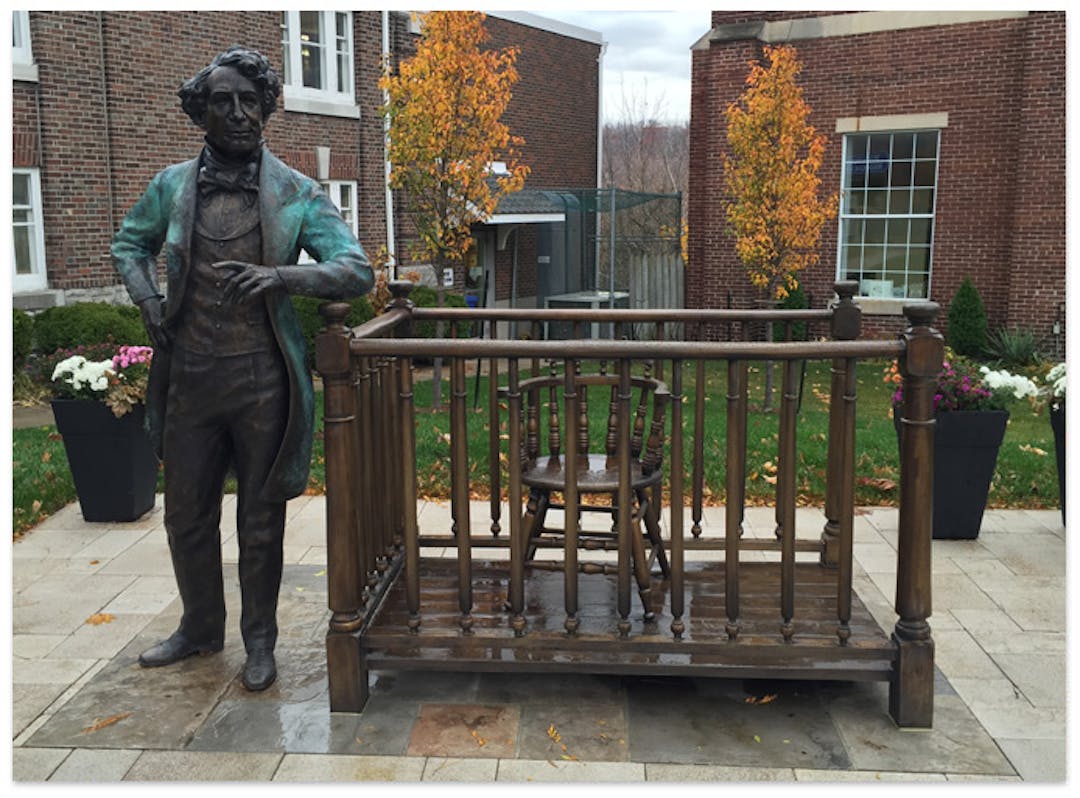
The “Holding Court” John A. Macdonald statue will remain in its current location on Picton Main Street following a decision by County Council at a special meeting on Tuesday, November 17. Read more on the County of Prince Edward website.
The Sir John A. Macdonald statue "Holding Court" was returned from storage to Picton Main Street at the Picton Library in early 2020 (after its original installation in 2015). Its return was a catalyst for conversation about Sir John A. Macdonald's past, within the broader context of colonialism. From this conversationContinue reading
Public feedback for this project has now closed.
The “Holding Court” John A. Macdonald statue will remain in its current location on Picton Main Street following a decision by County Council at a special meeting on Tuesday, November 17. Read more on the County of Prince Edward website.
The Sir John A. Macdonald statue "Holding Court" was returned from storage to Picton Main Street at the Picton Library in early 2020 (after its original installation in 2015). Its return was a catalyst for conversation about Sir John A. Macdonald's past, within the broader context of colonialism. From this conversation came the Prince Edward County Public Library's Speaker Series (Dr. Niigan Sinclair, Sarah Midanik, Kateri Lucier-Laboucan and Calvin Brook) addressed the need for projects which aim to restore Indigenous presence within communities, among other things. Other speakers were scheduled into March, but the COVID-19 pandemic caused the series to be cancelled due to public health measures.
The "Holding Court" Statue Working Group" was formed under the Prince Edward Heritage Advisory Committee (PEHAC) to conduct public consultation, research and ultimately to make recommendations to PEHAC about the future of the "Holding Court" statue. Their mandate is to advise PEHAC in their recommendation to Council in regard to the current installation in Picton of the "Holding Court" Sir John A. Macdonald statue.
Their goals are as follows:
- Follow the scope of the Truth and Reconciliation Commission's 10 Principles of Truth and Reconciliation
- Conduct research, carry out public consultation and prepare documentation, as necessary, to assist PEHAC in their recommendation to assist Council in their decision on the future of the Holding Court" statue
- Assist staff to prepare a report to PEHAC and ultimately Council by December 1, 2020, or as soon as feasible, outlining a recommendation for the future of the "Holding Court" statue.
Through this Have Your Say public engagement page, the Working Group will share information relevant to the public discussion, including their terms of reference, the 10 Principles of Truth and Reconciliation, and other documents (located in "Resources").
The Working Group would like to hear your views on what should be done with the "Holding Court" statue.
Individuals and organizations can tell the Working Group their views:
- Directly (in person or virtually) by presenting deputations (see "Deputation Guidelines" for more information on making public deputations)
- During a Town Hall event planned for Fall 2020.
- Via email to: ecowan@pecounty.on.ca
- By fax at: 613.476.5727
- By mail to: The "Holding Court” Statue Working Group, c/o County of Prince Edward, 332 Main Street, Picton, ON, K0K 2T0.
Please note that deputations and all comments are public.
Please explore the feedback options available on this page (below) to give your feedback. Register for updates to this page to get notified when new consultation tools are added as the Working Group progresses towards their goal.
In the words of Dr. Niigan Sinclair during his address in Picton, "What do we do with this history we have inherited together?"
Tell us what the Holding Court statue means to you?
-
Share The irony of holding court on Holding Court on Facebook Share The irony of holding court on Holding Court on X (formerly Twitter) Share The irony of holding court on Holding Court on Linkedin Email The irony of holding court on Holding Court link
The irony of holding court on Holding Court
by Fred Lester, about 6 years agoAll statues in the country which were duly commissioned by responsible people of the day should remain regardless of the emotions they instill. Defacing them is a crime against the society which placed them there. That Sir John is the focus of this debate is appropriate, being a symbol of democracy - yes, even with its flaws!
History cannot / must not be rewritten or that society loses its collective sense of direction. Through interaction in recent years with responsible indigenous people and a UA-Edmonton native studies course, I have been educated on the errors of our past and agree... Continue reading
All statues in the country which were duly commissioned by responsible people of the day should remain regardless of the emotions they instill. Defacing them is a crime against the society which placed them there. That Sir John is the focus of this debate is appropriate, being a symbol of democracy - yes, even with its flaws!
History cannot / must not be rewritten or that society loses its collective sense of direction. Through interaction in recent years with responsible indigenous people and a UA-Edmonton native studies course, I have been educated on the errors of our past and agree that promoting awareness is critical to our national identity. But without those points of reference, progress is irrelevant. Tearing up everything representing the path to where we are now is counterintuitive and a very slippery slope
Court must remain in session
-
Share A Time For Compromise on Facebook Share A Time For Compromise on X (formerly Twitter) Share A Time For Compromise on Linkedin Email A Time For Compromise link
A Time For Compromise
by Dennis Fox, about 6 years agoThere can be no doubt that across Canada, John A's statue has been the centre of discussion in many communities - PIcton is no different. I think by now most know of MacDonald's good and not so good history, so I am not going to repeat it. As a white male, it would be easy for me to take the position of doing nothing. That very approach is the reason why in the year 2020, we are now back dealing with an issue that should have been dealt with years ago - in other words maintaining the status quo solves... Continue readingThere can be no doubt that across Canada, John A's statue has been the centre of discussion in many communities - PIcton is no different. I think by now most know of MacDonald's good and not so good history, so I am not going to repeat it. As a white male, it would be easy for me to take the position of doing nothing. That very approach is the reason why in the year 2020, we are now back dealing with an issue that should have been dealt with years ago - in other words maintaining the status quo solves nothing and should not be considered.My suggestion is pretty straight forward - relocate the statue to the courthouse - the place where John A started his career. Along with the statue, a clear and factual historical account of his time as our PM - explaining his positiver contributions, along with the policies he supported and promoted that were clearly harmful to both our Chinese and Aboriginal communities.
The idea of perpetuating a myth or legend should never be confused with history. Canadian history is something to be proud of, but we can't ignore the truth - and isn't that what Truth and Reconciliation is all about? Truth doesn't change the history, but only adds to it. We only have to look south of our border to see how a the true history of a country has been so twisted over time, by movies and TV that this confusion now culturally divides that country. This opportunity we have to keep our history factual and honest cannot be squandered due to petty politics and personal feelings. It is time to prove that we understand and are prepared to compromise to make it right.
-
Share Bring it down! on Facebook Share Bring it down! on X (formerly Twitter) Share Bring it down! on Linkedin Email Bring it down! link
Bring it down!
by Claudia Dias Martins, about 6 years agoIt’s infuriating to see so much support for keeping a statue of a man who implemented racist policies and allowed for residential schools. I think it’s important for people to ask themselves why they feel so uncomfortable about the removal of a statue, but don’t feel the same degree of discomfort about the fact that our country was built on the genocide of Indigenous culture and continues to systematically oppress Indigenous people. This statue is not a symbol of an accurate history. It does not even begin to uncover the pain and intergenerational traumas Macdonald inflicted. This statue glorifies a... Continue reading
It’s infuriating to see so much support for keeping a statue of a man who implemented racist policies and allowed for residential schools. I think it’s important for people to ask themselves why they feel so uncomfortable about the removal of a statue, but don’t feel the same degree of discomfort about the fact that our country was built on the genocide of Indigenous culture and continues to systematically oppress Indigenous people. This statue is not a symbol of an accurate history. It does not even begin to uncover the pain and intergenerational traumas Macdonald inflicted. This statue glorifies a politician whose legacy quite frankly deserves condemnation.
-
Share Sir John A. MacDonald must stay, tearing down statues is not reconciliation. on Facebook Share Sir John A. MacDonald must stay, tearing down statues is not reconciliation. on X (formerly Twitter) Share Sir John A. MacDonald must stay, tearing down statues is not reconciliation. on Linkedin Email Sir John A. MacDonald must stay, tearing down statues is not reconciliation. link
Sir John A. MacDonald must stay, tearing down statues is not reconciliation.
by Grayson Pollard, about 6 years agoSir John A. MacDonald is responsible for making the great country all of us Canadians live in today. He created the country where us Canadians enjoy human rights, the rule of law, and a free and open democracy. Radical leftists, however are trying to take away the rights we were given as Canadians and subjects of the British Empire before Canadian Confederation. We must not give in. There is no legitimate reason to tear down these statues, as they resemble a part of our history. Sir John A. MacDonald may have been responsible for the horrible Residential Schools, but I... Continue reading
Sir John A. MacDonald is responsible for making the great country all of us Canadians live in today. He created the country where us Canadians enjoy human rights, the rule of law, and a free and open democracy. Radical leftists, however are trying to take away the rights we were given as Canadians and subjects of the British Empire before Canadian Confederation. We must not give in. There is no legitimate reason to tear down these statues, as they resemble a part of our history. Sir John A. MacDonald may have been responsible for the horrible Residential Schools, but I think we must acknowledge the negatives of our history, and celebrate the positives.
-
Share History speaks for itself. on Facebook Share History speaks for itself. on X (formerly Twitter) Share History speaks for itself. on Linkedin Email History speaks for itself. link
History speaks for itself.
by Paul Cole, about 6 years agoThe truth is there if we look hard enough, Reconciliation is a little more difficult in large part it relies on Trust. Trust that the right thing will be done based on the Truth thereby resulting in an equal footing or understanding. Inquiries and Commission's have been done and provided recommendations only to receive lip service through apologies and acknowledgements of the Truth ,without implementation of those recommendations the Trust issue rises again. Indigenous People have Trusted and Hoped for the right to be done since confederation based on Treaties and Agreements. Trust ???It worries me that a Member... Continue reading
The truth is there if we look hard enough, Reconciliation is a little more difficult in large part it relies on Trust. Trust that the right thing will be done based on the Truth thereby resulting in an equal footing or understanding. Inquiries and Commission's have been done and provided recommendations only to receive lip service through apologies and acknowledgements of the Truth ,without implementation of those recommendations the Trust issue rises again. Indigenous People have Trusted and Hoped for the right to be done since confederation based on Treaties and Agreements. Trust ???It worries me that a Member of "Holding Court" Statue Working Group who seems to be lobbying for support as a Guest Speaker at a local service club meeting recently, the story appears on the Countylive.ca website. He expresses concerns about conditions set in place by the Working Group. Again Trust becomes an issue.
"Erasing History" The irony of that phrase when you consider the fact that is exactly what John Macdonald tried to do to the Indigenous Peoples of Canada. Removing the "Holding Court" statue does not mean history is being erased in reality it means that True History is finally being acknowledged...
-
Share We learn from history on Facebook Share We learn from history on X (formerly Twitter) Share We learn from history on Linkedin Email We learn from history link
We learn from history
by sheilamgingras, about 6 years agoI can honestly say , I did not realize that Sir John A had anything to do with residential schools. Now I am aware- but only because of this statue and its significance. I think we can view it as a teaching moment. We cannot undo our past but we can learn and move forward with this knowledge.For sure he wasn't a saint -- but who among us is?
The other issue is that this was made and no doubt took a long time-- so are we not also offending the artist?
I realize Mohawks Of the Bay of... Continue reading
I can honestly say , I did not realize that Sir John A had anything to do with residential schools. Now I am aware- but only because of this statue and its significance. I think we can view it as a teaching moment. We cannot undo our past but we can learn and move forward with this knowledge.For sure he wasn't a saint -- but who among us is?
The other issue is that this was made and no doubt took a long time-- so are we not also offending the artist?
I realize Mohawks Of the Bay of Quinte are in the best position to say if it is offensive to them or not.
Can we not have a plaque beside it explaining the history including why the decision was made to keep it or not.
I think having the residents have our say is a great idea.
-
Share Tearing down Statues is not Reconciliation on Facebook Share Tearing down Statues is not Reconciliation on X (formerly Twitter) Share Tearing down Statues is not Reconciliation on Linkedin Email Tearing down Statues is not Reconciliation link
Tearing down Statues is not Reconciliation
by Dylan Gagnon, about 6 years agoSir John A. Macdonald's actions aren't acceptable to us today and emphasis should be placed on learning about his role in the creation of residential schools and the hardship he brought upon Indigenous communities, in addition to the role he played in founding Canada.
It must be remembered that even the Chair of the Truth and Reconciliation Committee on which this consultation is based, the Honourable Murray Sinclair, did not believe that tearing down statues was productive for the goals of reconciliation. In an article published in the Globe and Mail three years ago he was quoted as saying the... Continue reading
Sir John A. Macdonald's actions aren't acceptable to us today and emphasis should be placed on learning about his role in the creation of residential schools and the hardship he brought upon Indigenous communities, in addition to the role he played in founding Canada.
It must be remembered that even the Chair of the Truth and Reconciliation Committee on which this consultation is based, the Honourable Murray Sinclair, did not believe that tearing down statues was productive for the goals of reconciliation. In an article published in the Globe and Mail three years ago he was quoted as saying the following:
"The problem I have with the overall approach to tearing down statues and buildings is that is counterproductive to ... reconciliation because it almost smacks of revenge or smacks of acts of anger, but in reality, what we are trying to do, is we are trying to create more balance in the relationship."
Source: https://www.theglobeandmail.com/news/national/honouring-indigenous-heroes-better-than-debating-macdonald-sinclair/article36113299/
If Picton wishes to acknowledge the horrible actions taken by Sir John A. Macdonald and the damage they have caused and continue to cause First Nations communities, it should add a plaque to the statue, rather than taking it down. Similarly, if Picton wishes to promote the spirit of reconciliation, it should look to add a statue, monument or some other kind of recognition of local indigenous heroes rather than destroying what is already standing, simply because it seems like a popular move at the time.
-
Share A Look at History on Facebook Share A Look at History on X (formerly Twitter) Share A Look at History on Linkedin Email A Look at History link
A Look at History
by Deb Hudson, about 6 years agoThere is so much history that my generation was taught in school that needs to be reexamined. I remember having to memorize the names of all the kings and queens of England in grade 9 or 10 history class at Prince Edward Collegiate Institute. Aside from being extremely boring,, the history taught was not as relevant to me (a Canadian) as it could have been. I was not taught about the cruel legacy of the Residential Schools or inhumane treatment of the residents of Africville by Haligonian officials. How much of our history is missing in our collective consciousness?With... Continue reading
There is so much history that my generation was taught in school that needs to be reexamined. I remember having to memorize the names of all the kings and queens of England in grade 9 or 10 history class at Prince Edward Collegiate Institute. Aside from being extremely boring,, the history taught was not as relevant to me (a Canadian) as it could have been. I was not taught about the cruel legacy of the Residential Schools or inhumane treatment of the residents of Africville by Haligonian officials. How much of our history is missing in our collective consciousness?With regard to the statue of Sir John A on Picton's Main Street, I believe it should be moved to a museum with a more complete history of this person's actions. To be sure I am glad we have a country that is not part of the United States but we need to be aware of the huge cost to our First Nations people and to the Chinese labourers who built the railway.
It would be interesting to know how and what history is being taught in our schools today.
-
Share Reconsidering Sir John A. Macdonald on Facebook Share Reconsidering Sir John A. Macdonald on X (formerly Twitter) Share Reconsidering Sir John A. Macdonald on Linkedin Email Reconsidering Sir John A. Macdonald link
Reconsidering Sir John A. Macdonald
by Larry Tayler, about 6 years ago
I posted this essay about Sir John A. Macdonald to my blog, "Making Eye Statements" (LarryTayler.com) on August 2, 2020. It takes about fifteen minutes to read.
Reconsidering Sir John A. Macdonald
It’s time to reconsider my opinion of Canada’s first Prime Minister, Sir John A. Macdonald.
I’ve enjoyed studying history for over sixty years. Inspired by gifted teachers, I majored in Canadian history at university. The more I studied history, the more nuanced it became. I once naïvely believed that history was fixed – a universally agreed set of facts, dates, causes, and consequences. Frozen in time, never to... Continue reading
I posted this essay about Sir John A. Macdonald to my blog, "Making Eye Statements" (LarryTayler.com) on August 2, 2020. It takes about fifteen minutes to read.
Reconsidering Sir John A. Macdonald
It’s time to reconsider my opinion of Canada’s first Prime Minister, Sir John A. Macdonald.
I’ve enjoyed studying history for over sixty years. Inspired by gifted teachers, I majored in Canadian history at university. The more I studied history, the more nuanced it became. I once naïvely believed that history was fixed – a universally agreed set of facts, dates, causes, and consequences. Frozen in time, never to be reconsidered, only to be recalled.
Then I grew up.
The world was infinitely more complex than that. Disputed understandings of the present lead to disputed understandings of the past. New insights, evidence, and theories constantly arise and challenge established versions of events. I clearly remember the day a world-altering insight registered in my young mind: history depends on who writes it. And those who write it used to be the ‘winners’, predominantly white and male. Of the many revolutions currently roiling the marketplace of ideas, one of the most important has been the opening up of history to alternate perspectives, especially from disenfranchised, oppressed, and previously silenced voices. The cat and the mouse experience the same events very differently.
Which brings me to Canada’s first Prime Minister, John Alexander Macdonald, aka ‘Sir John A’.
Some background for non-Canadian readers: born in Scotland in 1815, Macdonald migrated with his family to Kingston, Upper Canada (now Ontario) in 1820. He started practising law in nearby Picton in 1833. His legal career took him back to Kingston and into politics. Ultimately, he became the prime architect of Canadian federation. Tradition calls him ‘The Father of Confederation’. As a result of his leadership, cajoling, and arm-twisting, the Dominion of Canada came into being on July 1, 1867, a date now designated as Canada Day. In the beginning, it comprised three British North American colonies: Nova Scotia, New Brunswick, and the Province of Canada (modern day Québec and Ontario). In subsequent years, Canada expanded to all the land mass north of the USA to the Arctic Ocean, with the exception of Alaska.
Macdonald was Prime Minister twice: from 1867 to 1873; and from 1878 until his death in 1891. He was a towering, controversial figure who inspired both passionate support and deep loathing. He spearheaded the building of the Canadian Pacific Railway to bring British Columbia into the federation, connecting the country with a line of steel in 1885 – but not without scandal, rancour, and violence.
Macdonald helped forge a country that arguably would have been swallowed up by the ravenous United States had he not stubbornly stood his ground.
I have always had a fond spot in my heart for Sir John A. He helped found the land of my birth, the land I call home, the land I love. He was a larger-than-life figure who strode this country like a colossus. His personal life was marked by grief and tragedy. He was a notoriously heavy drinker. He was deeply flawed.
And, it turns out, he was a racist, even beyond the standards of the late 19th century, when Canada’s predominantly white culture was pervasively and casually racist.
Which takes us to Canada’s infamous Residential Schools for Indigenous children and The Indian Act.
The Indian Act was passed by the Canadian Parliament in 1876. Although Macdonald was not Prime Minister when The Indian Act was initially passed, the law was based on The Gradual Civilization Act, passed under Macdonald’s leadership in 1857 – ten years before Confederation – by the legislature of the former Province of Canada. The Indian Act codified the relationship between the Government of Canada and the Indigenous peoples of this country. And The Indian Act is still in effect, although it has been amended over the years. It is a shockingly racist, paternalistic law that has traumatized tens of thousands of Indigenous people. In the early 1880s, when Macdonald was once again Prime Minister, Residential Schools for Indigenous children were established across Canada under the authority of The Indian Act. The goal of the Residential Schools was to strip Indigenous children of their cultures and languages and to force them to become ‘white’. The Indian Act legalized the forced removal of Indigenous children from their homes and families, followed by relocation to distant Residential Schools. Most were operated by the Roman Catholic Church and various Protestant denominations. In the words of Macdonald, “An indigenous child educated where he or she lives is simply a savage who can read or write.” In Residential Schools, Macdonald intended that the kidnapped children “acquire the habits and modes of thoughts of white men.”
The children were forbidden to speak their birth languages and forced to learn French or English. Their cultural practices were banned. And – appallingly – they were subject to massive abuse: sexual, emotional, and physical, often at the hands of priests and nuns. It is estimated that 150,000 Indigenous children were coerced into attending these schools from the 1870s until the last one closed in 1996.
1996!
The trauma suffered by these children is incalculable. Tragically, the trauma reverberates from one generation to the next. The profundity of the racism inflicted on the bodies, minds, and souls of these children is vast, nauseating, and heartless. And the wretched consequences continue to be felt in every corner of this land.
If you want to learn more about the obscenity of the Residential Schools, a sobering starting point is the 2015 final report of The Truth and Reconciliation Commission of Canada (TRC). The TRC was established in 2008 to document and assess the impact that Residential Schools had – and continue to have – on Indigenous peoples in Canada. The report’s unflinching honesty and rage needs to be required reading for every Canadian citizen. Its ninety-four “Calls to Action” remain, sadly, mostly unfulfilled.
The second element of Macdonald’s racist legacy was his attitude towards the Chinese. In 1885, he said in the House of Commons that allowing Chinese people to settle permanently in Canada would mean that “the Aryan character of the future of British America would be destroyed.” He also considered that the 1885 passage of The Electoral Franchise Act, which took the vote away from men of “the Mongolian or Chinese race”, to be his “greatest achievement.”
Completing Macdonald’s trifecta of racism, historians have uncovered evidence of his support for the Confederate cause in the American Civil War (1861-1865) and even suggest that these sympathies influenced his choice of the word “Confederation” to describe the new Canadian nation.
Let that one sink in.
(See “Reconsidering the Underground Railroad: Slavery and Racialization in the Making of the Canadian State” by retired Queen’s University/University of Toronto professor Abigail Bakan, Journal of the Society of Socialist Studies, Spring 2008, pages 18-19.)
So, when I examine John A. Macdonald’s legacy, I see institutionalized, state-sanctioned racism.
I often hear people say that we mustn’t judge the past by the standards of the present. I disagree. That’s what the modern study of history is predicated upon: contemporary eyes critically examining the past while discerning guidance for the future. And sometimes these contemporary historians discover that our past leaders behaved very badly indeed, even by the standards of their own day.
So the conundrum becomes: how do we recognize the contributions of such figures in our past, while acknowledging the profound damage their policies and actions caused?
Which brings us to Holding Court, the 2015 statue of Sir John A. Macdonald by the gifted Canadian artist Ruth Abernethy. The statue stands in front of the Picton Public Library and commemorates Macdonald’s first court case in Picton, October 8, 1834, although the details of this case are disputed.
Holding Court is the source of controversy in Prince Edward County: some staunchly defend the statue as a celebration of Picton’s – and Canada’s – heritage, while others want it removed because of Macdonald’s traumatic treatment of Indigenous peoples. Red paint has been thrown on it twice in recent weeks.
Full disclosure: in 2015 I donated money to The Macdonald Project, the organization that proposed and raised money for the creation of Holding Court. My opinions about Macdonald have evolved since then; were that fund-raising campaign held today, I would not support it.
The County of Prince Edward, the municipal government that is the custodian of Holding Court, has established a community consultation process about the statue’s future. Representatives of the nearby Mohawks of the Bay of Quinte are part of this process. I will follow the consultations closely.
My views: Holding Court cannot continue as it currently exists. The painful reality of Macdonald’s racism and treatment of Indigenous people demands – at the very least – contextualization and recognition of the ongoing trauma.
One option is to relocate Holding Court to Picton’s Macaulay Heritage Park for display in a museum setting.
In any case, it cannot stay where it is, as it is.
Another approach would be to remove the figure of Macdonald from Holding Court, while keeping the empty witness chair on public view. I like the powerful metaphor of that image – an eloquent reminder of my country’s unwillingness to acknowledge its past.
Thanks to the miracle of Photoshop, here's my version of Holding Court, without Macdonald. I recognize, by the way, that artist Ruth Abernethy might object to having the two elements her sculpture split apart.
So....to sum up:
I have had people – white people – tell me that, while they claim to understand the anger felt by Indigenous peoples about their racist treatment in the past, it is now time for them to let go of that anger and move on. In other words, “Get over it.” The mind-numbing racism of this thinking leaves me speechless. The racial wounds are so profound and deeply embedded in Canadian society that a simplistic push for ‘closure’ trivializes and exacerbates intergenerational Indigenous suffering, leading to further traumatization. Rather than healing the trauma, such a push merely reflects white reluctance to acknowledge Canada’s reprehensible treatment of Indigenous peoples.
I hope that this modest essay helps promote a healing path. Thank you for reading it..
-
Share Move It Elsewhere on Facebook Share Move It Elsewhere on X (formerly Twitter) Share Move It Elsewhere on Linkedin Email Move It Elsewhere link
Move It Elsewhere
by Ashley Reilly, about 6 years agoMy partner was born and raised in the county, half his life in Picton, and we've discussed at length what we think.Sir John A Macdonald's actual house is only a few blocks away, it is already used as a museum to teach about him. It makes the most sense to us for the statue simply to be moved there, as it's a more appropriate location, and have it be used as a teaching tool. Whether we agree with the man or not he played a significant role, in this area especially because he settled here, and erasing him does... Continue reading
My partner was born and raised in the county, half his life in Picton, and we've discussed at length what we think.Sir John A Macdonald's actual house is only a few blocks away, it is already used as a museum to teach about him. It makes the most sense to us for the statue simply to be moved there, as it's a more appropriate location, and have it be used as a teaching tool. Whether we agree with the man or not he played a significant role, in this area especially because he settled here, and erasing him does a disservice to our goal of not repeating past mistakes. He doesn't need to be showcased in the middle of town as an idol, or put on a pedestal, but the statue doesn't need to be destroyed either. A ground-level position outside his house with a plaque providing well-rounded and accurate historical information (Good, bad, ugly, etc) seems like a compromise that could appease both sides of this issue.
-
 Agendas & Meeting Notes
-
Resources & Further Reading
-
 Municipal World Podcast - Interview w. Ava Hill Pt. 3
-
Municipal World Podcast - Interview w. Ava Hill Pt. 2
-
Municipal World Podcast - Interview w. Ava Hill Pt. 1
-
The Survivors Speak - Report of the TRC Canada.pdf (8.29 MB) (pdf)
-
Ryerson - TRC Community Report.pdf (347 KB) (pdf)
-
Framework-for-History-and-Commemoration-2019.pdf (6.55 MB) (pdf)
-
Final Report - Working Grp on Principles of Commemoration and Renaming.pdf (937 KB) (pdf)
-
United Nations Declaration of the Rights of Indigenous People.pdf (150 KB) (pdf)
-
Truth & Reconclitation Commission, 10 Principles of Reconcilliation.docx (19.9 KB) (docx)
-
-
History of "Holding Court" statue

-
Heritage Advisory Committee Working Group
County of Prince Edward
HC -
Phone 613-476-2148 x2503 Email ecowan@pecounty.on.ca -
NL

-
Open
"Holding Court" John A. Macdonald Statue has finished this stageThis consultation is Open for contributions.
-
Under Review
"Holding Court" John A. Macdonald Statue has finished this stageContributions to this consultation are closed for evaluation and review. The Project team will report back on key outcomes.
-
Final report
"Holding Court" John A. Macdonald Statue is currently at this stageThe final outcomes of the consultation are documented here. This may include a summary of all contributions collected as well as recommendations for future action.